




DigiMach Workshops report

DigiMach Workshops report
DigiMach Workshops: Key Takeaways on Digital Transformation for Machining SMEs in the Meuse-Rhine region
The DigiMach project organized three workshops in Liège, Genk and Aachen, bringing together machining SMEs to discuss their digitalisation challenges and practical solutions across five pillars: Process Setup, Process Monitoring, Quality Control, Machine Health and Operator Assistance.
Digital Maturity Snapshot
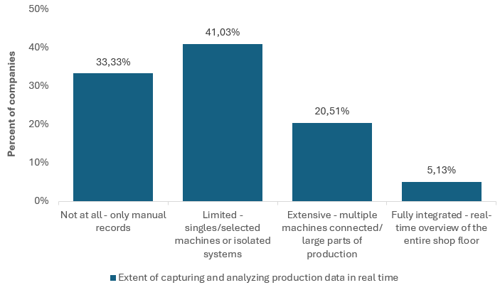
This figure illustrates the current state of real-time production monitoring among the participating machining SMEs.
The survey shows that digitalisation in machining companies is still often partial and rarely integrated into daily operations. Many companies collect data, but it is not systematically used to support decision-making.
- 74% of companies have little or no real-time digital monitoring of their production processes
- 87.5% do not use integrated digital systems for quality assurance
- 75% still rely on reactive or time-based maintenance instead of data-driven approaches
Together, these results explain why companies frequently report limited visibility of ongoing production, delayed detection of issues, and difficulties in anticipating machine or quality problems.
Workshop Insights by Pillar
Process Setup
Companies face inconsistent programming methods, high tooling costs, and fragmented workflows. Participants highlighted the need for standardized procedures, shared tool libraries, and digital work plans, with growing interest in IoT and digital twins to improve preparation efficiency.
Process Monitoring
A major priority is gaining real-time visibility of production. SMEs are looking for affordable sensors and unified dashboards that provide clear, actionable information and allow earlier detection of process deviations.
Quality Control
Quality inspection remains largely manual and time-consuming. Companies see strong potential in automated inspection, vision systems, and integrated traceability tools to identify defects faster and reduce scrap.
Machine Health
Maintenance is still mainly reactive. Participants expressed interest in predictive maintenance solutions capable of detecting early machine deviations and providing simple alerts rather than complex datasets.
Operator Assistance
Skills shortages and training challenges are increasing. Digital work instructions, AR guidance, and interactive tutorials were identified as promising solutions to transfer knowledge and standardize shopfloor practices.
Key Lessons Across the Workshops
Across the three locations, similar patterns emerged. SMEs are interested in digitalisation, but solutions must remain simple, affordable, and compatible with existing machines and workflows.
Four recurring needs were identified:
- Easy integration into current systems
- Clear added value for operators and managers
- Practical insights rather than raw data
- Better knowledge transfer and training support
These shared priorities confirm that adoption depends less on technology availability than on usability and tangible benefits on the shopfloor.
What Comes Next
The workshops provided a clear view of SMEs’ needs. DigiMach will now translate these insights into demonstrators, pilot projects and training activities, allowing companies to progressively test and adopt practical digital solutions in their own production environment.