


About Interreg

What is Interreg?
Interreg is one of the key instruments of the European Union (EU). It supports cross-border cooperation through project funding. Interreg-funded projects tackle common challenges together and find shared solutions.
What is Interreg Meuse-Rhine (NL-BE-DE)?
Step into the vibrant landscape of Interreg Meuse-Rhine (NL-BE-DE). The programme was previously known as Interreg Euregio Meuse-Rhine (EMR). We are one of the oldest cross-border cooperative initiatives in the European Union.
At Interreg Meuse-Rhine (NL-BE-DE), we empower projects that unite partners across borders. We support innovative solutions for shared challenges in Belgium, Germany, and the Netherlands. Here, collaboration transcends national and regional borders.

What is the budget that the programme can invest in projects?
From 2021 to 2027, we invest a total of EUR 176 million to address our region's grand societal challenges. EUR 125 million of this money comes from the European Union.

Grand societal challenges
After years of ground-breaking progress, we're standing on the cusp of even greater change. Interreg Meuse-Rhine (NL-BE-DE) has identified five transformative societal challenges – opportunities waiting to be unleashed. Join us in seizing this moment to improve the lives of people and shaping a brighter future for all in our programme area. Let's make a profound impact on these crucial areas:
Industrial transition
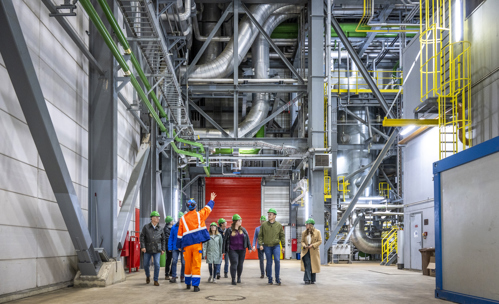
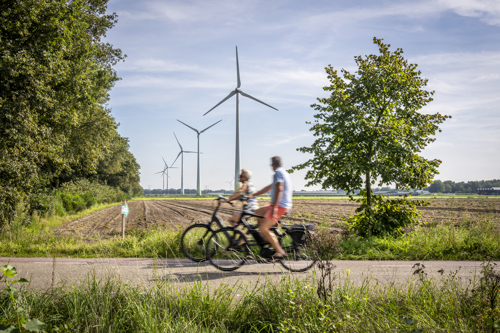
Green Transformation
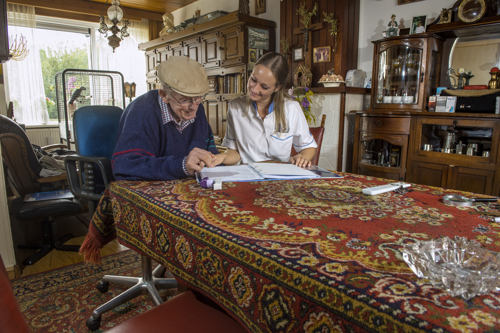
Healthier citizens
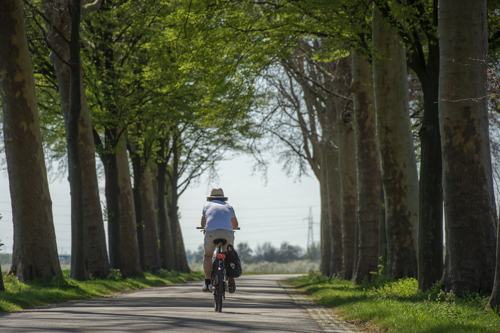
Tourism in a high-quality region
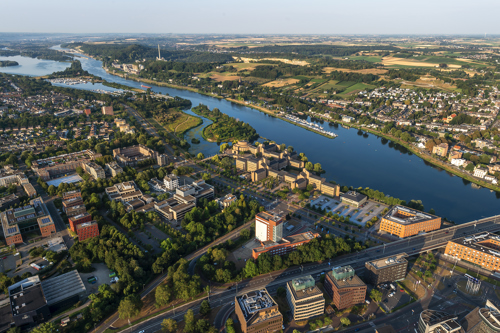
Live and work without borders
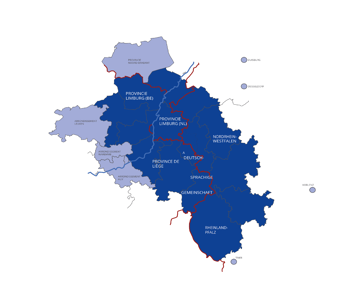
Programme area and programme partners
The core area of Interreg Meuse-Rhine (NL-BE-DE) encompasses the southern part of the Dutch province of Limburg, the Belgian provinces of Limburg and Liège, the German-speaking community in Belgium, the German Region Aachen (with the districts of Aachen, Düren, Heinsberg and Euskirchen), as well as the Eifelkreis Bitburg-Prum and Landkreis Vulkaneifel in Rhineland-Palatinate.
For the 2021-2027 programming period, however, Interreg Meuse-Rhine decided to extended the scope beyond administrative programme boundaries to include “functional areas”. These areas, although outside the programme's core area, boast interdependencies and links that intricately connect them to our overarching objectives. It's a strategic leap toward a more interconnected and expansive collaborative landscape, where geographical limits no longer define the extent of our impact. Join us in breaking new ground as we redefine the scope of collaboration in the pursuit of shared objectives. Practically, this means that partners located outside the programme area can apply for and participate in projects, as well, as long as the benefit for the programme area is clear.
Our esteemed programme partners encompass key entities from each of these countries:
| Belgium | Germany | The Netherlands |
|
|
|
This partnership reflects the programme’s commitment to fostering collaboration and development across borders. Together, we are making a meaningful impact through the Interreg Meuse-Rhine programme.
Programme bodies
At the heart of Interreg Meuse-Rhine (NL-BE-DE), a number of authorities and organisations from the Netherlands, Belgium, and Germany jointly shoulder the programme's responsibilities:
Monitoring Committee (MC):
Our Monitoring Committee is an assembly of representatives from programme partners, local and regional governments, and social and economic stakeholders. As the highest governing body, the MC steers the fundamental decisions that propel our programme forward.
Steering Committee (SC):
Under the watchful eye of the MC, the SC takes the helm in selecting projects that contribute to our programme goals.
Managing Authority (MA):
The Provincial Executive of the Province of Limburg has been designated by the European Commission as our Managing Authority. The MA has the official responsibility and accountability for the programme to the European Commission (EC). The MA manages the programme on behalf of the participating programme partners, ensuring their vision comes to life.
Joint Secretariat (JS):
The Joint Secretariat is managing the administrative and technical processes of the programme. The JS, alongside the RAs, takes the lead in communication, publicity, and reporting.
Regional Antenna (RAs):
Meet the friendly faces at the frontline – our Regional Antennas. They're your first point of contact, providing programme information in local languages, guiding you to cross-border partners, and offering support for crafting high-quality project applications.
Audit Authority (AA) / Group of Auditors:
Ensuring the effective functioning of our management and control system is the responsibility of our Audit Authority, led by the director of the “Auditdienst Rijk” of the Netherlands. The AA conducts audits that keep our programme and projects on track.
-

Provincie Limburg (NL)
-
Provincie Limburg (BE)
-
Province de Liège
-
Ministerium der Deutschsprachigen Gemeinschaft Belgiens
-
Ministerie van Economische Zaken en Klimaat
-
Ministerium für Wirtschaft, Verkehr, Landwirtschaft und Weinbau Rheinland-Pfalz
-
VLAIO (Agentschap Innoveren & Ondernemen)
-
Wallonie
-
Region Aachen Zweckverband
-
Fédération Wallonie-Bruxelles
-

Ministerium für Wirtschaft, Industrie, Klimaschutz und Energie des Landes Nordrhein-Westfalen